

 Admin
AdminWhy your frustration is fueling the future
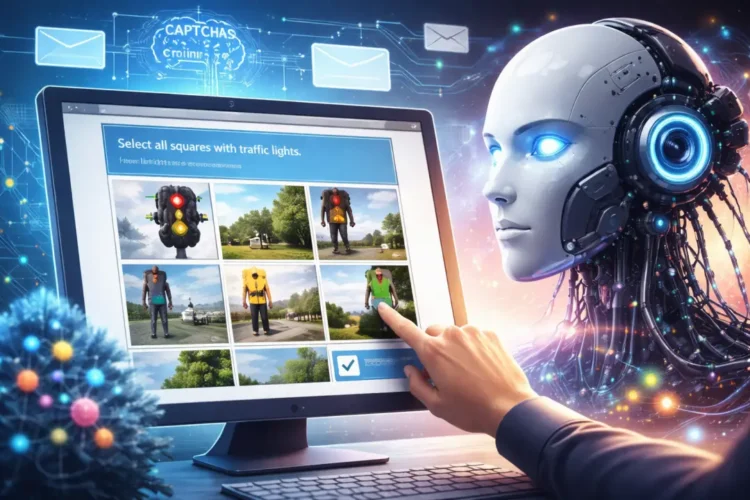
We have all been there. You are trying to log into a website, you are in a hurry, and suddenly you get hit with a grid of grainy photos. “Select every square that contains a traffic light,” the screen demands. You squint, you click, and you pray you didn’t miss that tiny sliver of a pole hanging off the edge of one box.
It is annoying, right? But here is the part that usually slides under the radar: Are CAPTCHAs training AI? actually acting as a massive, free labor force for tech giants. Every time you identify a crosswalk or a bus for a website, you aren’t just proving you are human. You are effectively teaching an AI how to see the world.
Also check this: 7 Shocking Secrets About Resetting Your PC That Can Destroy Your Data. Are CAPTCHAs training AI? — Here’s what you need to know.
The hidden history of your clicks
Back in the day, CAPTCHA (s) were simple. They were just squiggly letters and numbers designed to stop spambots from creating fake accounts. It was purely about security. But eventually, the researchers behind this tech realized they had a unique opportunity. They had millions of people doing repetitive visual tasks every single day. Why waste that human brainpower on just security?
That is when things shifted. Companies started feeding their image recognition software the data they couldn’t figure out themselves. Those blurry photos of street signs? They were images from Google Street View that the computer couldn’t quite identify. By solving those puzzles, you were digitizing addresses and helping AI navigate our roads.
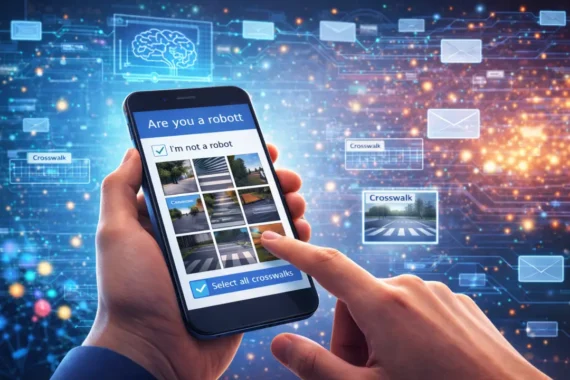
Fix Truth explained (Are CAPTCHAs training AI?) – How the training process works
Think of it as a massive school project. When you solve a captcha, you are acting as the teacher. The AI makes a guess about what is in an image, and your click confirms whether it is right or wrong. When thousands of people agree that a certain blurry blob is a bicycle, the AI learns a pattern. Next time, it doesn’t need to ask you anymore.
Quick Tip: Notice how the captchas seem to get harder? That is because the AI is already good at the easy stuff. It only gives you the tricky, high-uncertainty images that it genuinely needs help with.
The AI feedback loop
This is where it gets interesting. Once the AI learns from us, it becomes better at its job. It can identify objects faster and more accurately. Then, it uses that improved vision to create new, even more complex challenges. It is a never-ending cycle of us teaching the machines to surpass us.
You might be thinking, Isn’t that a bit sneaky? Well, it is certainly clever. They get free data, and we get access to the website we were trying to reach. It is a trade, but it is one most of us never signed up for explicitly.
Why your input is so valuable
You might wonder why a supercomputer can’t just do this on its own. The truth is that machines are great at math, but they are often terrible at context. They can count pixels, but they struggle to understand the nuances of a partially hidden stop sign in the rain.
This is where human intuition comes in. We have an uncanny ability to recognize objects even when the conditions are subpar. That ‘human’ touch is what the developers are paying for with those few seconds of your time. You are providing the ground truth that labels the internet’s messy data for the next generation of neural networks.
Is it just about cars and signs?
Not at all. While street imagery is the most famous use case, captchas are actually(Fact: Are CAPTCHAs training AI?) training AI in a variety of fields. They help with:
- Handwriting recognition: When you decipher those old, messy handwritten documents, you are helping AI transcribe historical records that a computer could never read on its own.
- Object labeling: From identifying types of trees to spotting specific clothing items in fashion photos, your clicks help categorize the visual web.
- Behavioral patterns: Some modern invisible captchas track how you move your mouse. They are learning how humans act versus how bots act, refining their security algorithms in the process.
The downside of the system
The main issue here is the lack of transparency. Most people assume they are just filling out a security check. They aren’t aware that their ‘work’ is being used to build proprietary AI models that might eventually replace the very jobs they do in their personal or professional lives. It is a bit dystopian when you look at it through that lens, isn’t it?
Looking at the bigger picture
I don’t think we need to go on strike against captchas. Let’s be real, they do keep the internet from being overrun by malicious bots. However, it is worth keeping in mind that the web isn’t just a place where we consume content. We are part of the infrastructure.
Every time you find yourself getting frustrated by a hydrant in a photo, remember: you aren’t just wasting time. You are participating in a massive, real-time training session for a machine that is constantly getting smarter. It is a bizarre reality, but it is the one we live in.
I hope the fact that “Are CAPTCHAs training AI” is not unknown to you now. Keep reading, keep shining.
FAQs
1. Are CAPTCHAs training AI systems?
Yes, modern CAPTCHA systems, especially Google reCAPTCHA, can use human responses to improve AI models. When you solve image-based challenges, your input may help train machine learning systems to recognize objects more accurately.
2. Why do CAPTCHAs ask you to select traffic lights or buses?
These challenges exist because CAPTCHA(s) are training AI to identify real-world objects. Selecting traffic lights, cars, or crosswalks helps improve computer vision systems used in technologies like self-driving vehicles.
3. What is the hidden purpose behind CAPTCHA tests?
Beyond blocking bots, the hidden purpose of CAPTCHA is to collect human-verified data. This data can be used to train AI models in areas like image recognition, text digitization, and behavioral analysis.
4. How does Google reCAPTCHA use human input?
Google reCAPTCHA analyzes user interactions and responses to challenges. This input is often used to refine AI algorithms, making them better at understanding images, patterns, and human behavior online.
5. Are CAPTCHA images used for machine learning?
Yes, many CAPTCHA images are part of datasets used in machine learning. When users correctly identify objects, that data can be fed into AI systems to improve their accuracy over time.
6. Is solving CAPTCHAs helping improve artificial intelligence?
In many cases, yes. While the primary goal is security, solving CAPTCHAs can also contribute to AI development by providing labeled data that helps machines learn faster and more effectively.
For more details, check the official guide: Microsoft Support.