
 Admin
AdminThe compression trap—4K videos on YouTube facts
When a creator uploads a video to YouTube, they aren’t just hitting a button and walking away. YouTube’s servers have to re-encode everything. Think of it like making a photocopy of a photocopy. Every time you compress a video to make it uploadable, you lose data. By the time a 4K video reaches your screen, YouTube has stripped away so much of the “bitrate”—the actual amount of data per second—that the image quality drops significantly.
You might have 3,840 pixels horizontally, but if the color information and fine textures are being crushed by aggressive algorithms, you’re really just looking at a pixelated, glorified 1080p image.
Also check this: Did you know? Actually, the internet weighs about as much as a single strawberry. Truth About Most is something many people search for, and understanding it properly can save you time and effort.
I’ve tested this by downloading raw 4K footage from a high-end mirrorless camera and comparing it side-by-side with the same file uploaded to YouTube. The difference is heartbreaking. The original file has these delicate gradients in the sky, and you can see the texture of the fabric on a shirt. On the YouTube version? It looks like the sky is made of blocky bands of color, and the shirt looks like a flat, plastic blob. The resolution is there, but the fidelity is long gone.
Why creators aren’t entirely to blame
It’s easy to point the finger at YouTube, but there’s another side to this. Most creators are working within the constraints of what YouTube allows. If you upload a massive, high-bitrate file, the platform will just crush it anyway. Many YouTubers optimize their export settings to prioritize file size and upload speed rather than raw quality. They know that if their video takes five hours to process or if it buffers endlessly for their viewers, they lose the audience.
So, they intentionally “soften” their videos before they even hit the upload button. It’s a trade-off between accessibility and raw visual perfection.
This is where it gets interesting: the “look” of a video often matters more to a creator than technical specs. If a video is shot in a dark room with poor lighting, no amount of 4K resolution is going to make it look professional. A well-lit 1080p video will almost always look better than a poorly lit 4K one. Yet, because the YouTube algorithm loves the 4K label, creators feel pressured to upscale their footage, even if it was originally captured at a lower resolution. They’re chasing the badge, not the quality.
That is the bitter truth of many existing and newly uploaded 4K videos on YouTube.
Common mistakes to avoid when judging video quality
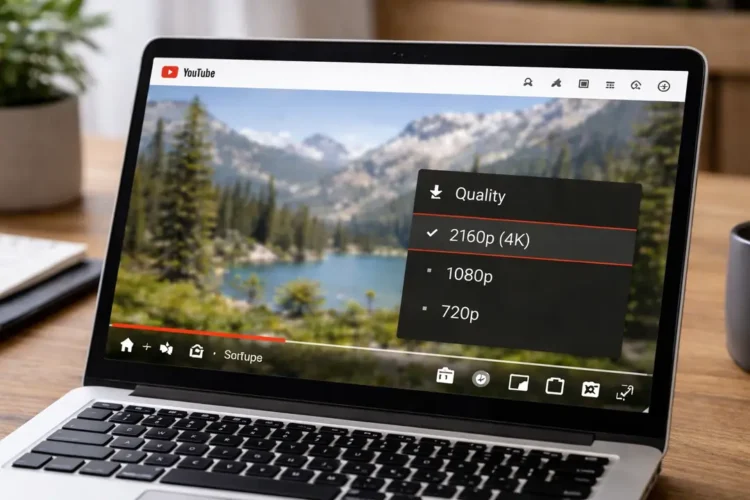
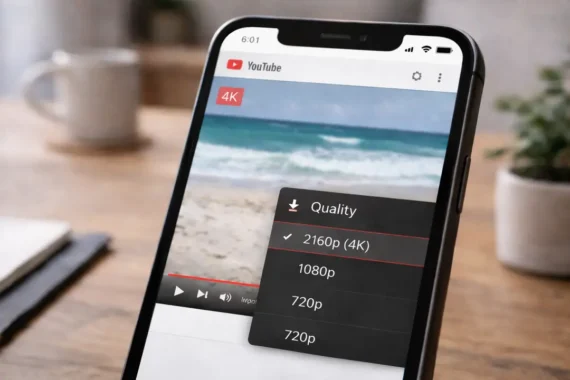
I see people constantly make these assumptions when judging whether a video is actually high quality. First, stop looking at the “Quality” settings menu as the final word. Just because it says 2160p (the technical term for 4K) doesn’t mean you’re getting cinema-grade output. Many people assume that if their internet is fast, they are seeing the best version of the video. But if the source file was poor, the fastest fiber connection in the world can’t magically restore details that weren’t captured in the first place.
Another major mistake is ignoring the display you’re using. I’ve seen people complain about 4K quality while watching on a laptop screen that can’t even reach 1080p resolution. You aren’t getting the full benefit if your hardware isn’t up to the task. Moreover, people tend to obsess over resolution while entirely ignoring bitrate.
Resolution is how many pixels you have; bitrate is how much data fills those pixels. Think of it like a painting: resolution is the size of the canvas, but bitrate is the quality and amount of paint you use. If you use a giant canvas but only have a tiny drop of paint, you’re going to have a lot of blank space.
The reality of upscaling and AI enhancement
We’ve entered an era where AI-upscaled content is everywhere.
You’ll see old footage from the 90s appearing in “4K remastered” videos, and you’re assuming that all the 4K videos on YouTube are actually real 4K videos. Now, there is some impressive tech out there, but let’s be honest: it’s an educated guess. The computer is essentially filling in the gaps with pixels it thinks should be there. While it looks cleaner, it’s not “true” 4K. It’s an interpretation. When you watch this stuff, you have to be aware that you’re looking at algorithmic art, not a faithful reproduction of the original source.
In my own workflow, I’ve found that the best-looking YouTube videos aren’t necessarily the ones with the highest-resolution tag. They are the ones filmed with professional-grade glass, high-end sensors, and exported with a sensible bitrate that hits that sweet spot between file size and detail retention. When you find a channel that actually cares about its encoding process, it’s like night and day. You can actually see the difference.
FAQs for – 4K videos on YouTube
Is watching 4K on YouTube ever actually worth it?
Absolutely. Even with the compression, a 4K source file on YouTube will almost always look better than a 1080p file of the same video. YouTube uses a higher bitrate codec (often VP9 or AV1) for 4K, which means even though it’s compressed, the baseline quality is still significantly higher than the standard 1080p stream.
Why does my 4K videos on YouTube look blurry sometimes?
It’s likely a combination of network congestion and YouTube’s adaptive streaming. YouTube is constantly monitoring your connection speed. If it detects even a slight dip, it will drop the bitrate of the video to prevent buffering, which turns your crisp 4K into a smudgy, low-data mess. Try pausing the video and letting it buffer for a minute to see if the quality stabilizes.
Does “4K” mean the same thing on every platform?
Not at all. A 4K movie on a Blu-ray disc will look vastly superior to a 4K video on YouTube or Netflix. Physical media has a much higher bitrate ceiling—sometimes three to four times higher—than what streaming platforms allow. Streaming has to be optimized for the masses, while Blu-ray is optimized for the highest possible fidelity.
Should I force my settings to 4K even if my screen isn’t 4K?
Yes, but for a specific reason: super-sampling. Even if you have a 1080p screen, forcing the YouTube player to 4K forces the platform to send you a higher-quality stream (higher bitrate). Your computer then shrinks that image down to fit your 1080p screen. The result is a much sharper, cleaner picture than if you had just selected 1080p natively.
How can I tell if a video is truly high quality or just “fake” 4K?
Look at the fine details. Check for “macro-blocking”—those little square artifacts that appear in dark areas of the screen or in fast-moving scenes (like water or explosions). If the image looks soft or feels like there’s a “filmy” layer over the top, the bitrate has been crushed. True high-quality 4K looks sharp, vibrant, and maintains detail even in high-motion sequences.
Related Topics
youtube bitrate, video compression artifacts, 4k vs 1080p, streaming quality issues, video encoding explained
Related Articles
- Top 5 best Chrome extensions for productivity
- Did you know? Actually the internet weighs about as much as a single strawberry
- Top 5 best cloud storage services for 100% privacy
- How To Unlock Windows Laptop Using Your Phone (The Easy Way)
- Top Secrets of Incognito Mode! It does not hide your activity from your ISP- The truth about incognito
For more details, check the official guide: Microsoft Support.